The Common Man Speaks

Didn’t consider W Indies as big opponent in ’83 World Cup, says Mohinder Amarnath

June 26, 2022 by Keyur Seta Leave a Comment

The 1983 cricket World Cup-winning team had another reunion last evening in Mumbai at the launch of the coffee table book titled The 1983 World Cup Opus, facilitated by Paymentz.

The event saw the presence of Kapil Dev, Mohinder Amarnath, Kirti Azad, Roger Binny, Syed Kirmani, Madan Lal, Sandeep Patil, Balwinder Singh Sandhu, Krishnamachari Srikkanth, Dilip Vengsarkar, Sunil Valson and the then team Manager PR Man Singh. Ravi Shastri and Sunil Gavaskar, who were also a part of the team, joined the event virtually.

The event saw the 1983 team go down memory lane and recall interesting stories behind their triumph.

Much before the final of the world cup, India had beaten West Indies in their very first league match of the series. This was a huge hurdle to cross because before this match, the West Indies hadn’t lost a single match in the world cup from 1975 onwards when the series started.

1983 World Cup
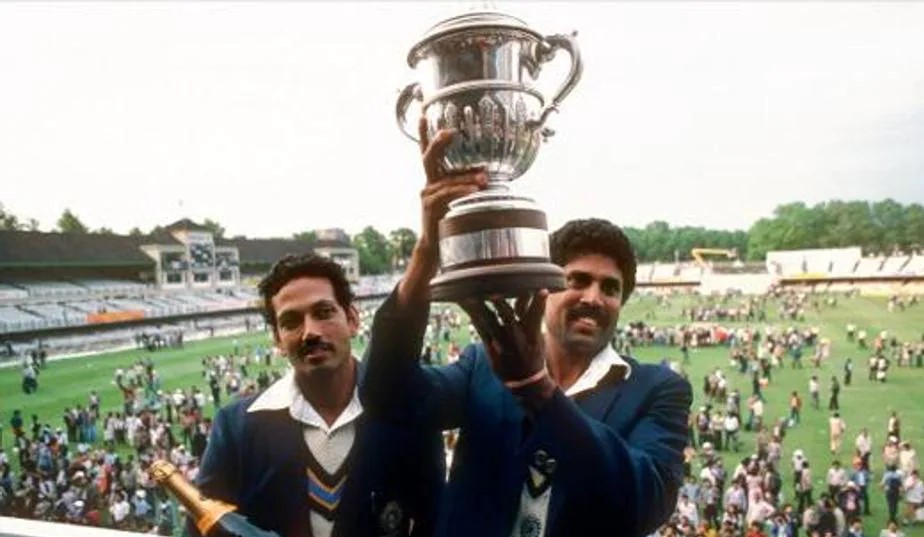
Mohinder Amarnath and Kapil Dev after winning the 1983 World Cup

Speaking about the victory, Amarnath said, “If you trust yourself and have the guts, you can do anything. We didn’t consider West Indies as a very big opponent. To be very honest, this was my way of thinking. [But] I am sure all 11 players on the field were also thinking this way that we are better than them. This is what made us the world champions. We clicked at the right time.”

The event was also attended by Anupam Harshad Vassa, the Founder and Chairman of Paymentz, and Amoolya Vassa, the Founder and Managing Director of the firm, along with other dignitaries from the same firm.

During the course of the discussion, it was recalled how defeating England in the semi-final was also an important landmark since India was not given a chance by many. “It was a crucial, crucial game,” said Ravi Shastri. “England were firm favourites, at least in their media. When you open the newspapers in the morning, it was only England. India was as if we are the outsiders and we have absolutely no chance.”

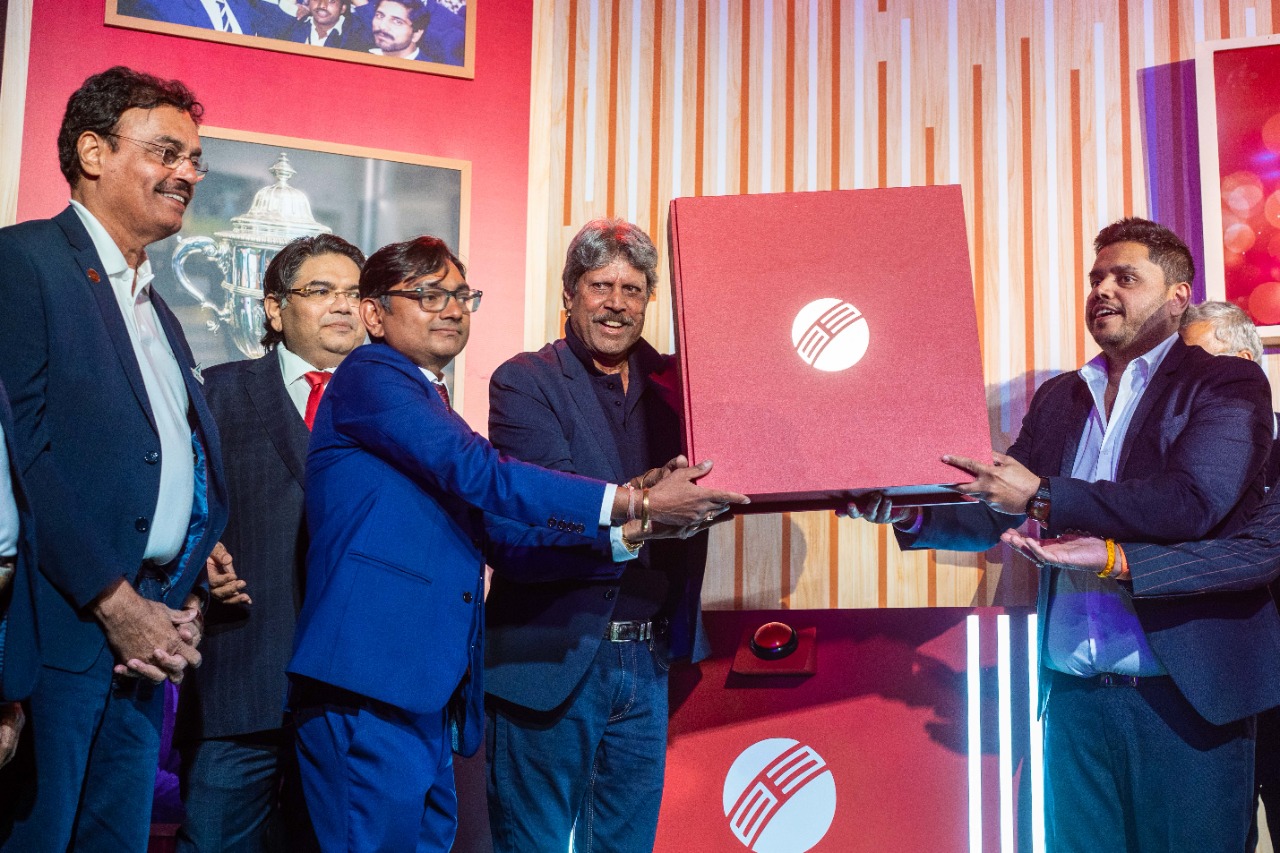
The launch of the book at the hands of Kapil Dev

The final of the ’83 world cup changed with the wicket of the legendary Vivian Richards whose catch was taken spectacularly by Kapil Dev off the bowling of Madan Lal. The bowler revealed that this wasn’t the first time he got Richards out.

“I wanted to bowl that over. I would like to tell you that I had also got him out 2-3 times before in the Calcutta test match and in West Indies. Once the umpire gave him not out in my bowling in Sharjah when he was clean LBW,” said Lal.

Also read: He was selected in ’83 World Cup, but could play only in ’99

Not much is said about the 22 run last-wicket partnership which involved Sandhu, who scored 11 not out batting at number 11. Sandhu recalled that without that partnership, India’s score would have been much lower.

“Last wicket partnership is always very crucial,” said Binny. “If he (number 11 batsman) is not out, then how many runs are made (in the last-wicket partnership) are made by him because if he had gotten out, the runs wouldn’t have been made.”

1983 World Cup team
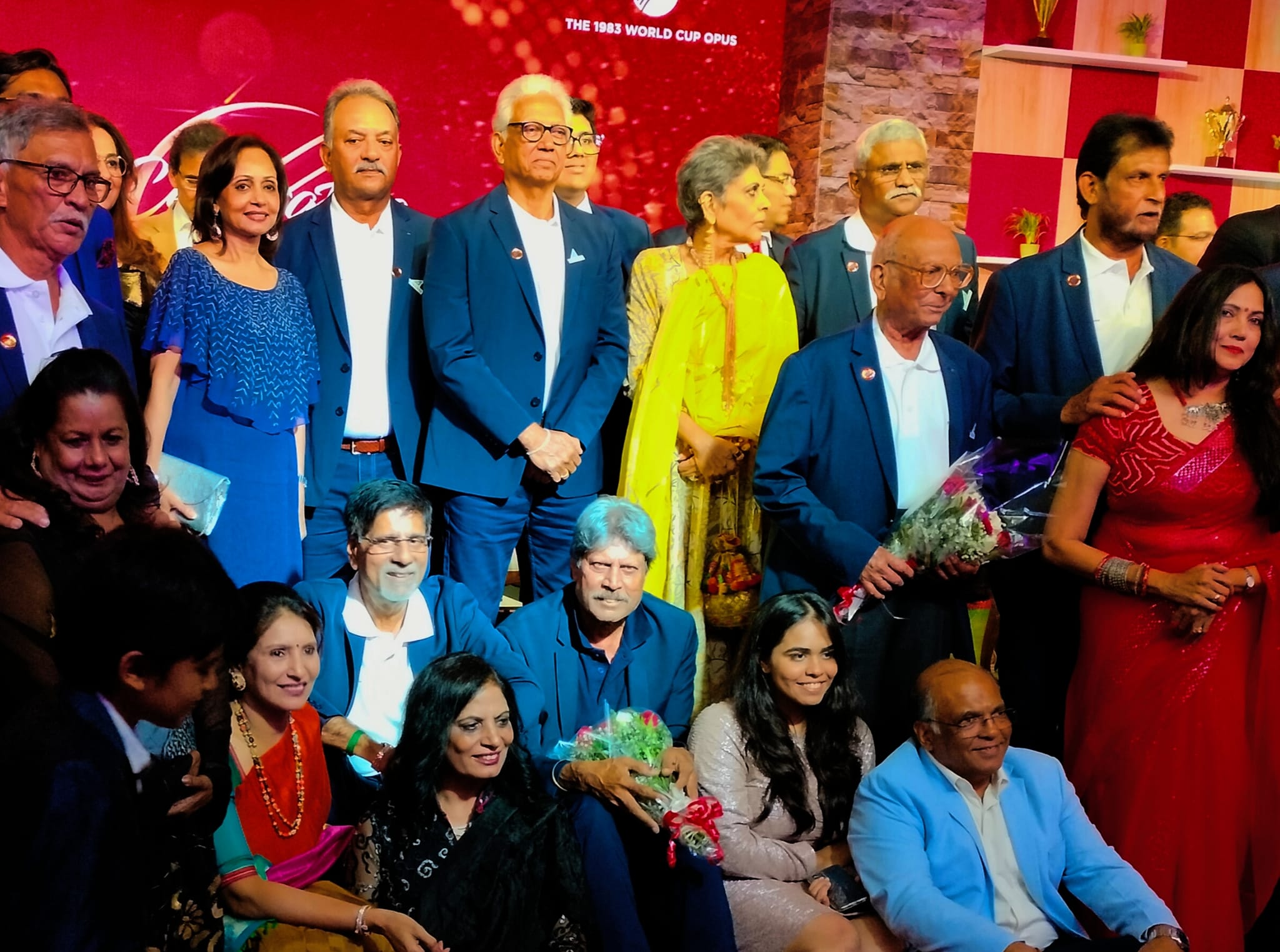
The 1983 team with their families

India looked favourite to win the World Cup final after West Indies were 6 or 7 down. But Kapil Dev didn’t think that way.

When Harsha Bhogle, the host, asked him when during the match he felt that the World Cup is theirs, Dev said, “(After getting the) last wicket,” said Dev. “How Jimmy bowled and he got the LBW, I think it was just a different feeling. Before that, you do think that it was possible. But it’s not possible till the last wicket. I think that’s the most important thing.”

Also read: 83 movie review

The ’83 team captain also said that it is only in recent years that the team is getting more recognition for the victory. “In last 10 years, I have felt it more. Now we are getting more respect and honour. It is something you can’t express in words. If you would have asked that day (after the final), I would have said that life is normal. We played the next series and we lost,” he said.

Filmmaker Kabir Khan, who made a film on India’s victory in that World Cup titled 83, was also present at the event.

Speaking about the event, Anupam Harshad Vassa said, “It was a no brainer and being cricket fans ourselves, we just grabbed the opportunity. The 1983 World Cup win put India on the world map. It was a proud moment for any Indian. Being a part of the ‘1983 World Cup Opus’ is an honor for Paymentz, and it is only the beginning of the company’s involvement in the sporting industry and recognition of cricket legends. Cricket is a religion in India and to be associated with the sporting giants, the first team who won the World Cup for India and gave us one of the most iconic sporting moments, is an honor for our company.”

Filed Under: Cricket Tagged With: 1983 World Cup book, 1983 World Cup incidents, 1983 World Cup Opus book, 1983 World Cup Paymentz, 1983 world cup quotes, 1983 world cup team

Play review: Dhappa (Hindi)

June 25, 2022 by Keyur Seta Leave a Comment

Writer, director, lyricist and producer Akshay Mishra’s Dhappa is a Hindi musical play based in the 1950s era of Hindi cinema. This description will make you expect the drama to play out in a certain way. However, it has a major surprise later on; something you don’t expect from a play of this genre.

Produced by Aum Theatre Mumbai, Dhappa takes place in 1950s Mumbai (then Bombay). Kumar (Pavitra Sarkar) is passionate about acting but he is unable to make it big in the industry. Worse, his crass and rude behavior has made him infamous in the media, especially the tabloids.

Kumar stays with his elder sister Iravati (Sharon Chandra) in a bungalow. She is a gifted Kathak dancer but has been unable to fulfill her wish of becoming a professional artiste. She is much more mature than Kumar and is his guiding force as well as critic.

Dhappa Hindi play

Meanwhile, the successful foreign-returned novelist Shyam (Puneet Issar) is eager to make his first feature film. Despite being obsessed with the idea of his first film, he doesn’t like watching new Hindi films. He is introduced to Kumar in an unusual way.

Shyam’s idea to make a film gains Kumar’s interest as he feels he will cast him in the lead role. However, Kumar is actually interested in making a film based on Kathak with Iravati. But this doesn’t go well with Kumar. He plainly declines the offer on behalf of Iravati without even asking her. Is it due to jealously, patriarchy or something else?

Dhappa takes you back to the golden right at the onset with Pankhuri Gangwal’s introduction as an anchor.

Pavitra Sarkar and Puneet Issar

The story is laced with a lot of drama and conflict and that is played out well on the stage on a majority of the times. Akshay Mishra’s fine presentation of various situations as a director is noteworthy. The elaborated scenes between Kumar and Shyam are a mixture of drama and humour. Kumar’s conversations with Iravati are more serious and deep.

Dhappa boasts of some rich set designing with minute detailing that brings back the bygone era. The use of lights is creative while the background score adapts to different emotions effortlessly. Ajit Kumar Srivastava, Amit Ranjan Srivastava and Radha Srivastava’s musical performances elevate the play.

Pavitra Sarkar succeeds in adding life to the character of Kumar. Along with arrogance, he also displays an undercurrent of vulnerability, which the people outside are unaware of. Sharon Chandra scores well both in her Kathak performances and while playing Iravati. Anuradha Athlekar provides decent support in a role that has more potential later.

Dhappa Sharon Chandra
Sharon Chandra

The veteran Puneet Issar lives up to his name and gives a mature act, including a long monologue. His character’s comparison with Duryodhan in one scene is amusing and smart.

On the flipside, Dhappa needed to be lesser in duration, especially in the second half where the length is felt. The duration of the song performances could have been reduced in order to make it crisper.

This point, however, won’t hurt you much when the aforementioned twist takes place. The way in which it is presented has the potential of giving you a shock, even if you manage to predict it.

Writer, director, lyricist and producer: Akshay Mishra

Cast: Puneet Issar, Sharon Chandra, Pavitra Sarkar and Anuradha Athlekar

Singers and musicians: Ajit Kumar Srivastava, Amit Ranjan Srivastava and Radha Srivastava

Background score: Amit Sagar

Lights: Shyam Chavan

Also read: Play Review: Subodh Bhave-starrer Ashrunchi Zali Phule

Filed Under: Plays Tagged With: Aum Theatre Mumbai, Dhappa Hindi natak, Dhappa Hindi play, Dhappa play Puneet Issar, Dhappa play review, Dhappa Puneet Issar

What Aamir Khan said about Shivling & why is his film boycotted?

June 12, 2022 by Keyur Seta 5 Comments

Over the last few years, every time an Aamir Khan film gets ready for release, one particular message or meme related to him starts circulating on social media and What’s App. As you must have guessed, it’s shared by the Right Wing fanatics with an appeal to boycott his upcoming film.

With the release of Laal Singh Chaddha not being far, the same message has started circulating again.

The message claims that Aamir once said in his television show Satyamev Jayate that instead of pouring milk on Shivling, it is better to use that money to feed a poor person. Hence, the message appeals to the audience to boycott his next release and use the money you would have spent on the ticket to help the needy.

How true is the message?

The message is fake. Aamir has never said that in Satyamev Jayate. In fact, a topic related to religion or religious beliefs was never addressed in that TV show. Some messages also claim that the actor made that comment in his blockbuster PK (2014). This claim is also false.

Still, if someone can find a video of him saying such a thing, please pass it on. Not that him saying such a thing would justify the boycott, more so after you read below.

Aamir Khan boycott
Aamir Khan in PK and Paresh Rawal in OMG Oh My God!

Who said it then?

Interestingly, the message against pouring milk on Shivling was given by Paresh Rawal’s character Kanjibhai in his film OMG Oh My God (2012). In fact, the character in the movie shares an in-depth and hard-hitting opinion on why it is futile to pour milk on the Shivling, as can be seen from the scene below.

But it doesn’t end here. During the promotion of the same movie, Akshay Kumar, who plays Lord Krishna in it, gave a bold personal opinion on why one shouldn’t pour milk on the Shivling. In fact, he didn’t stop at that. He also criticized the practice of pouring oil on Lord Hanuman’s deity on Saturdays. Watch the video below.

Those spreading communal hatred on the internet and social media have turned a blind eye at Rawal and Akshay’s comments. It is impossible that they are completely unaware about the comments made by these two actors, considering how much research their IT cell carries out.

But don’t expect any such boycott messages for these two actors since their surname isn’t Khan. As we all know, Rawal is also a member of the BJP (Bharatiya Janata Party) and an MP (Member of Parliament). Akshay’s fondness for the party is known far and wide.

We are reminded of it every time we eat a mango.

Also read:

Rann keeps getting more relevant and that’s not a good sign

Filed Under: Bollywood, Socio/Political Tagged With: Aamir Khan boycott, Aamir Khan Shivling, Aamir Khan Shivling comments, Laal Singh Chaddha boycott, Why Aamir Khan boycott

Samrat Prithviraj is a cinematic version of a What’s App forward

June 4, 2022 by Keyur Seta Leave a Comment

Dr Chandraprakash Dwivedi’s Samrat Prithviraj is supposed to be based on the life of the 12th century king and warrior Prithviraj III or Prithviraj Chauhan. The film focuses on his enmity with Muhammad Ghori of Ghazni in acquiring control over Delhi.

The film’s artistic camerawork and vibrant costumes make it an eye-pleasing affair. Some stunts during the battle scenes also stand out. From the performances, Sonu Sood is the best of the lot with a mature act as Chand Bardai.

But these positives are too few in number when it comes to the minuses. The film has a haphazard narrative throughout. For example, it starts on a tense note but soon loses grip and this is maintained throughout the duration. The forceful inclusion of songs adds to the misery.

A major negative point here is the casting of Akshay Kumar as Prithviraj. The actor never appears in character and it seems he wasn’t even interested in getting the body language right. Debutant and Miss World 2017 Manushi Chhillar has the looks but is pretty average when it comes to acting chops. And the less said about the awkward age gap between the two the better.

But these issues don’t appear as problematic as the film’s political propaganda. It is easy to forgive bad content, which is made aplenty in Hindi cinema, as it’s not intentional. But it’s difficult to overlook propaganda dished out to please the Right Wingers. This, surely, can’t be unintentional.

Prithviraj movie

The film’s makers, during various promotional events, stated that the film is based on actual facts and that Dwivedi carried out research for as many as 18 years. However, such gigantic effort is never seen in Samrat Prihviraj.

(SPOILERS ahead)

Historical accounts state that Prithviraj was killed by Ghori. Astonishingly, the film goes onto show that it was Prithviraj who killed Ghori whereas the latter lived more than the former. It is one thing to take creative liberty. It’s altogether another thing to change an entire narrative of history just to suit your real target audience, which is ready to accept whatever is dished out to them if it suits their narrative.

If they are ready to believe textual ‘information’ in What’s App forwards, they will obviously believe the same forwarded message portrayed on the screen in a grand scale. That’s what this film is – a cinematic version of a What’s App forward.

Amidst such problematic content, the film, out of nowhere, makes you laugh unintentionally when Sanyogita heroically sings ‘Yoddha Ban Gayi Main’ and, while the song is ending, commits jauhar [self-immolation].

Strangely, the promotions of Prithviraj Chauhan also saw Dwivedi claiming that the film is based on the text Prithviraj Raso, a poem written by Chand Bardai. Now this particular text is past-historical and part-fictional. So why also claim that the film is a historical account?

But the film doesn’t do justice even with Prithviraj Raso. The text mentions that after marrying Sanyogita, Prithviraj spent too much time with her while ignoring the state affairs. Nothing of this is shown in the film.

Of course, this would have been too much to bear for their What’s App audience. So the writer-director omits this part. This is exactly how one prepares a What’s App forward.

But it’s surprising that their real audience is fine with the film claiming Prithviraj to be the ‘last Hindu king.’ They don’t remember various other Hindu kings born much later, including Shivaji Maharaj?

Irony just committed jauhar…

Also read:

Why are south films dominating? Is Bollywood on the decline?

Filed Under: Bollywood Tagged With: Prithviraj Chauhan story, Prithviraj movie review, Prithviraj Raso, Prithviraj real story, Prithviraj story, Samrat Prithviraj review

This actor played both Ram and Sita in a movie

May 29, 2022 by Keyur Seta 2 Comments

Legendary filmmaker Dhundiraj Govind Phalke aka Dadasaheb Phalke gave birth to Indian cinema after he made the very first Indian movie Raja Harishchandra in 1913. Hence, he is known as the father of Indian cinema.

Phalke was smitten by the Hindu mythology. Hence, his films were mostly based on various mythological tales. One such film he made four years after Raja Harishchandra was Lanka Dahan.

Lanka Dahan is based on one episode from the epic Ramayana. Sita is abducted by Ravana and kept in Lanka [now Sri Lanka]. Her husband Lord Rama joins hands with his greatest devotee Hanuman along with his vaanar sena [army of animals] to help free Sita. In order to confirm if Sita is indeed in Lanka, Hanuman flies off to the island and finds Sita over there.

He presents the ring given by Rama as his identity and proof. While Hanuman is about to return, he is captured by Ravana’s army and is presented in the court. Ravana orders Hanuman’s tail to be set on fire. As soon as his tail is ignited, Hanuman escapes from the court and burns the entire city of Lanka with his tail [Hence, the title Lanka Dahan. Dahan translates to “setting anything on fire”].

Anna Salunke as Sita in Lanka Dahan
Photo courtesy: Wikipedia

Hanuman escapes from Lanka and gets reunited with Rama at the other shore of the Indian ocean. His act gives a blow to Ravana’s morale.

Women weren’t allowed to act in movies in those days. So it was a common practice to cast men in female characters after working a lot on their look and attire. Actor Anna Salunke regularly played female characters in Phalke’s movies. The filmmaker had cast him for the first time in his first aforementioned movie Raja Harishchandra.

Salunke used to work in a small restaurant in the Grant Road locality of Mumbai. When Phalke was struggling to find a female to play the role of Taramati in Raja Harishchandra, he, out of sheer co-incidence, came across Salunke in the restaurant. After getting convinced that he can be a good fit for Taramati, Phalke immediately cast him. Salunke continued his association with the filmmaker in his future films.

Salunke achieved a rarest of the rare feat in Phalke’s Lanka Dahan after he was cast as both Rama and Sita in the movie. The reason for casting the same actor in both the roles isn’t known. But it made Salunke the first actor in Indian cinema to play a double role.

Even more than 100 years after the film released, this remains a rare feat of a man playing the role of two people of two different genders in one movie. In the picture above, Salunke is seen as Sita.

This trivia was recently shared in the event CineTalkies in Mumbai organized by the Information and Broadcasting Ministry.

Rare find of a scene from Lanka Dahan:

Also read:

Review of Harishchandrachi Factory – based on the making of Phalke’s first movie

Filed Under: Regional cinema Tagged With: Anna Salunke, Anna Salunke actor, Dadasaheb Phalke Lanka Dahan, Dadasaheb Phalke movies, Lanka Dahan, Lanka Dahan movie

Book review: On The Deathbed by Karthik K B Rao

May 22, 2022 by Keyur Seta Leave a Comment

To say that the Coronavirus or COVID-19 played havoc in the world in the last two years or so would be an understatement. It made people go through hell and changed the way of life for the entire world.

This was more evident during the second wave of the virus. When the first wave subsided, many of us assumed that the worst was over but that turned out to be false and how. Many healthy individuals literally went through horrid times.

One of those unfortunate ones was author Karthik K B Rao. His book On The Deathbed: My Encounter With The COVID-19 Virus lists down his ordeal after getting infected and his fightback in a narrative form.

Karthik and his wife Sushma got infected with the virus in May 2021. While his wife’s condition wasn’t severe, the same wasn’t the case with Karthik. The virus started affecting him at such a high level that he started facing numerous issues, including low oxygen levels. It was an uphill task to get him admitted in the ICU (Intensive Care Unit) of a government hospital.

On The Deathbed book

But that wasn’t the end of the ordeal for Karthik. It was actually the beginning. He had to be shifted to a private hospital in the middle of the night as his condition deteriorated further and there were doubts being raised about his survival.

The aforementioned description of the content might give an idea that On The Deathbed is a sad or, at least, a very serious book. But that is far from the case. While the book does narrate how he went through hell and had to struggle even to carry out the simplest of tasks as answering nature’s calls, it is told in an engaging manner with regular doses of witty and, at times, dark humor.

In fact, after finishing the initial few pages itself, I forgot that On The Deathbed is non-fiction. It actually appears more like those survival genre films like Trapped (2017). Just like the film, we feel for the protagonist here as he goes through a rollercoaster ride of survival. There is a feeling of relief in the end, although we know beforehand that Karthik has survived.

Also read: Book review – The Hidden Hindu

A surprise element is the portion in the end written by his wife Sushma. One realizes that she went through a bigger hell than her husband. Even this aspect is narrated like gripping fiction.

The author is able to achieve the means despite using simple, everyday language that can appeal even to an ordinary layman, just like his earlier book The Mahabharata Code.

The only minus point here is the author addressing the virus as ‘Chinki virus’ once. This could have been avoided as it sounds problematic.

Overall: On The Deathbed: My Encounter With The COVID-19 Virus is a gripping tale of survival of a couple that went through hell during the second wave.

Rating: 4 out of 5

Publishers: Notion Press

Pages: 124

Price: Rs 200

Filed Under: Literature Tagged With: Coronavirus book review, Covid 19 book, Karthik Rao author, On The Deathbed book, On The Deathbed book review, On The Deathbed review

Puneet Issar to play a film director in the period musical play Dhappa

May 19, 2022 by Keyur Seta 5 Comments

The last time veteran actor Puneet Issar was seen on stage was in his mythological play Mahabharata: The Epic Tale where he played the iconic character of Duryodhan for which he is known.

He will now be seen in a completely different production titled Dhappa in the role of a foreign-returned filmmaker named Shyam.

Written and directed by Akshay Mishra, the play is produced by him and Sharon Chandra for Aum Theatre Mumbai. Chandra is also one of the actors in the play and she will also be performing an eight-minute kathak dance. She is a trained Kathak dancer from Jaipur Gharana. She is originally from Fiji Islands and has worked in numerous plays.

The play also stars Pavitra Sarkar and Anuradha Athlekar.

Dhappa is based in the film industry of Bombay in the 1950s. Kumar is a struggling actor who could never make it big. He is also infamous in the media for his rude and crass behavior. Even though acting was never his choice, he still tried to keep the flame alive only for his sister Iravati, whose ambition of dance could never be a reality.

Along comes Shyam, a foreign-returned director who is going to film his dream project. Shyam soon becomes a friend and confidant to Kumar. Kumar is overjoyed thinking that maybe he will get a chance to prove his mettle as a successful actor. But Shyam has other plans in mind.

Dhappa Hindi play

Speaking about the play and his casting, Issar said in a statement, “It is an utmost delight working with Akshay Mishra and Aum Theatre Mumbai. My role in Dhappa is something that I have never explored but have always yearned for. I remember asking Akshay why he thought of me for the role as I have always played opposite characters. I always wanted to play a soft-spoken character but never got the opportunity. This young team is very close to me and they are my people. I am excited for everyone to see Dhappa and believe me this magnificent play is here to stay!”

As part of this performance, Issar will also be seen giving a monologue titled Patthar Ke Pankh, which was written decades ago by his father Mr Suresh Issar, a noted director and producer.

On how the play came into being, Mishra said, “These two years, I resorted to re-watching some old movies and I was still mesmerized. Movies from the 1950s and 60s are never a one-time watch. The dances, music, costumes, and sets were so endearing. One always looks up to these veterans who have worked tirelessly and given us such invaluable gems. We are forever indebted to their work which gives us a glimpse of a beautiful era gone by. I wanted to recreate some of that time through a play. And Dhappa was born!”

He added, “But it was not an easy feat. I researched a lot on the types of thumris that were played during that era and endeavored to write thumris that resonated with my audience. I was inspired by the thumris sung by Shamshad Begum, Begum Akhtar, Siddheshwari Devi, and many more and tried to recreate a little sprinkle of that golden era that these maestros ruled in. I can’t wait for the audience to hear these beautiful pieces of music.”

Mishra has also written the lyrics for the play, including the thumris. He is famous for his experimental play Nangi Aawazein, based on a short story by Saadat Hasan Manto.

The play will feature live singing from singers, Radha Srivastava, Amit Ranjan Srivastava and Ajit Kumar Srivastava.

Dhappa will be premiered on 18 June at Bandra’s St. Andrews Auditorium at 7 pm.

Filed Under: Plays Tagged With: Dhappa Aum Theatre, Dhappa Hindi natak, Dhappa Hindi play, Dhappa play, Dhappa Puneet Issar, Dhappa Puneet Issar play

Why Kaluwitharana’s stint in ’96 World Cup is overrated

May 4, 2022 by Keyur Seta 2 Comments

Note: The aim of this article is not to insult or badmouth Romesh Kaluwitharana. This is just an attempt to present some facts and statistics that are generally overlooked when it comes to the 1996 World Cup

The 1996 World Cup turned out to be memorable because an underdog team like Sri Lanka not only emerged victorious but played like true champions throughout. Aravinda De Silva became the hero for them in the final against Sri Lanka at Lahore where he scored an unbeaten 107 and picked up 3 wickets.

But a large amount of credit has been given to Sri Lanka’s openers Sanath Jayasuriya and Romesh Kaluwitharana. Both the batters were given the license to go after the bowling right from the word go and score as many runs as possible during the field restrictions (15 overs).

Both were known to revolutionize the role of opening batters. They started opening the batting in the series in Australia just before the 1996 World Cup and it worked during that tour.

Romesh Kaluwitharana

Till today, Jayasuriya and Kaluwitharana are known as the destructive opening pair of the 96 cup. I have read numerous articles saying the same and heard commentators over the years glorifying both of them as dangerous batters of that series.

However, that is far from true. There is no doubt that Jayasuriya had a great world cup both with the bat and the ball and was rightly adjudged the man of the series. But to say that Kaluwitharana was also a success story in that series doesn’t sound logical.

While this might sound harsh, that isn’t my intention here. Just have a look at his scores in the whole series:

v/s Zimbabwe: 0

v/s India: 26

v/s Kenya: 33

v/s England: 8

v/s India: 0

v/s Australia: 6   

ESPNCricinfo in an article says “he [Kaluwitharana] was an integral figure in Sri Lanka’s astonishing World Cup victory that winter.” But his aforementioned performances tell a completely different story. He played 6 innings in that series and his total number of runs amount to just 73! His average comes down to just 12.16.

When you say that a batter had a good world cup, one would expect at least one score of 50 from him. If not this, there should be at least few scores in the 30s and 40s as that would have helped the team get a good opening partnership. But Kaluwitharana scored in double figures just twice.

He gave a good start to Sri Lanka in just two matches and one of them was against an associate team that was playing international cricket for the first time. On top of that, he had two golden ducks. He failed to score in all the three matches in the knockout stage where his total remained just 14 runs.

How can he be considered a ‘integral figure’ in Sri Lanka’s victory? You can’t be considered an important contributor to the team if you don’t contribute.  

Kaluwitharana’s overall career was surely much better than this. He was a good partner for Jayasuriya before and after the 1996 World Cup. But to say he was a part of a destructive opening pair in the 96 cup would be more than an overstatement.

Also read:

One of Wasim Akram’s biggest achievements is forgotten

Filed Under: Cricket Tagged With: Kaluwitharana 96 World Cup, Kaluwitharana and Jayasuriya, Kaluwitharana batting, Kaluwitharana record, Romesh Kaluwitharana 1996 World Cup, Romesh Kaluwitharana stats

Why south films are dominating? Is Bollywood on the decline?

April 26, 2022 by Keyur Seta 3 Comments

The last six months, ever since theatres re-opened all across India at the end of last year, have seen some major box office hits in India. The top three of them have been from the south Indian film industry. These include the likes of Pushpa: The Rise, RRR and KGF Chapter 2.

Interestingly, apart from their original languages, these films they have also done phenomenally well in its Hindi dubbed versions in the Hindi belts of India – regions where predominantly Hindi films work.

They have also outperformed quite a few big-ticket Hindi films that were expected to do well. This is forcing a lot of people to ask the question as to why south films are working big time in the Hindi markets these days, especially on social media.

Going by the films that have succeeded, the answer to the question is simple. These films are finding massive audience base because these are entertaining films. Over here, entertaining means absolute mass entertainers.

These are films where a popular hero (or heroes) with a good amount of fan following plays a rough and tough character who can beat the hell out of the bad guys, gets to mouth some heroic dialogues and shake a leg on fast dance numbers. Pushpa, RRR and KGF fall in these categories of films and were decent content-wise too. Hence they have achieved massive success all over the country.

This is also giving rise to the question whether Bollywood or Hindi film industry is on the decline. It is being said on numerous occasions that south industry is all set to dominate and put behind the Hindi industry. I read a lot enthusiastic comments on social media daily where someone or the other states that Bollywood is slowly getting finished or is sinking.

RRR KGF

I personally feel these are baseless statements. One needs to understand that there has been a change in the way audience consumes films in the post-pandemic era. People are visiting theatres in large numbers only for massy commercial films that provide larger-than-life entertainment.

That’s the reason why the aforementioned south films have done so well. And that is also the reason why Rohit Shetty’s Sooryavanshi became a runaway hit and that too at a time when there was uncertainty at the box office. After all, it was the first big Hindi film to release post-pandemic and the producers themselves weren’t sure how it would perform. But it had non-stop entertainment and this was enough for the cash registers to start ringing.

The same can be said about the success of Gangubai Kathiawadi. It might be a film about the life of a sex worker but it was narrated by Sanjay Leela Bhansali in a larger-than-life and entertaining manner. It was also helped by the presence of superstar Alia Bhatt who showed as much confidence and swag as any hero in a hero-centric massy film.

The Kashmir Files is an exception as it’s not a typical Bollywood movie. It created massive interest for people of a particular political ideology who felt it’s their duty to watch this film in theatres. This doesn’t mean that those with a different political view didn’t see the film.

On the other hand, films like Chandigarh Kare Aashiqui, Badhaai Do and Jersey have failed despite getting positive reviews and word-of-mouth. This is because they were sensible, content-oriented films and not the larger-than-life masala entertainers.

Hence, as per the change in audience consumption, they didn’t do well in theatres. People are preferring to watch such type of films on OTT [over-the-top] platforms. Now, a film worth watching in theatre has to be a big-screen experience. A major proof of this change is that even someone like Ayushmann Khurrana, who was considered a bankable star before the pandemic, couldn’t help the cause of Chandigarh Kare Aashiqui.

Of course, Satyameva Jayate 2 was also aimed as a massy entertainer but the film got rejected because of its terrible content. The film at least needs to be decent to be successful. Because of the same reason, the Hindi version of Radhe Shyam sank despite the presence of the Baahubali actor Prabhas. The same was the cast with Vijay’s Beast. So it’s not at all big south films are doing well in Hindi.

There’s no denying that the quality of Hindi films in recent times hasn’t been up-to-the-mark or at high standards. The industry has been criticized for its obsession with remaking successful south Indian movies over and over again.

But this certainly doesn’t mean that Bollywood is sinking or is on the decline. It’s just that only commercial films with big stars and decent content are doing well right now because of the change in audience’s manner of consumption.

The big commercial films lined up for release from here onwards are expected to do well if the content is decent enough. Can’t say the same about films that are thought-provoking and not aimed at the masses as these films are now considered worthy only for OTT.

This will go on at least till the near future. After that, things may or may not change.

Also read:

Can we stop giving unreal reasons for 83’s box office failure?

Filed Under: Bollywood Tagged With: 2022 box office, 2022 box office collection Bollywood, Hit films of 2022, Hit films of 2022 Bollywood, KGF 2 box office collection, RRR box office

When Sachin, the bowler, bailed out India in THRILLING situations

April 23, 2022 by Keyur Seta Leave a Comment

Sachin Tendulkar is considered the legend of the game and the best batsman to have played the game. But those who have grown up alongside his career would know that he was an underrated and underused bowler.

Sachin Tendulkar

Tendulkar has had a number of successes with the ball, including two 5-wicket and 4-wicket hauls. He picked up 154 ODI wickets and 46 test wickets in his long career. But apart from being the highest wicket-taker in these matches, he also rolled his arm over for just an over or even a ball in situations that were purely nail-biting in few ODIs; where the match could have gone anywhere but for his calm and calculative bowling.

These are those moments:

Hero Cup: India vs South Africa (1993):

This was a must-win match for both teams as it was the semi-final. The winner was set to play either West Indies or Sri Lanka in the final. The match, as Ravi Shastri would say, went right down to the wire. India batted first and were all out exactly at 50 overs for just 195. South Africa never got going and struggled during the chase.  

In the end, South Africa needed 6 off 6 balls with 8 wickets down. During this time, skipper Mohammad Azharuddin gave the ball to Tendulkar. After getting Fanie de Villiers runout of the first ball, he literally made Allan Donald dance on his tunes by not allowing him to take any run on the next three balls. McMillain, the set batsmen, stood frustrated at the other end.

Donald finally got a single on the fifth ball and McMillain needed to score a boundary off the last ball. He was unable to connect well and just managed to take a single. India won by two wickets.

Titan Cup: India vs Australia (1996):

Tendulkar had a phenomenal record against Australia with the bat. But he has also made life tough for the Aussies with the ball. He had a 5-wicket and 4-wicket hall each against them in 1998. But he also had a small but major achievement with the ball against Australia in the unofficial semi-final of the Titan Cup in 1996 in Chandigarh. The winner of this match was to play South Africa in the final.

This situation was similar to the one in the Hero Cup semi-final. India scored 289 for 6 batting first with skipper Azharuddin again top-scoring with 89. This match also turned out to be a thriller with Australia needing 6 runs of the final over. Sachin was the captain on this occasion. He decided to bowl the last over himself. Again, he hadn’t bowled in the entire innings.

Tendulkar bowled a length ball to Brad Hogg who looked good in that innings. He tried to play the sweep but got hit on the pads and there was an appeal for LBW. McGrath, at the other end, took the run but Hogg was busy watching the ball. Hence, it was too late for him to reach the other end as keeper Nayan Mongia succeeded in a direct hit. India won by 5 runs.

Benson & Hedges World Series: India vs West Indies (1991)

This is one of the most underrated heroics of Tendulkar with the ball. It was the first match of the Benson & Hedges World Series between India and West Indies and it ended in a tie. Tendulkar had a major role to play in it.

In this low-scoring match at Perth, India were bundled out for just 126. In reply, West Indies kept losing wickets at regular intervals, which ensured that India was always in the game. This was the match where Javagal Srinath got Keith Arthurton bowled in the famous way after squaring him up.

When West Indies were reduced to 113 for 9, it looked like India would win from there on. But a gutsy last wicket stand between Anderson Cummins and Patrick Patterson got them on par with India’s score of 126.

This was the first time that captain Azharuddin threw the ball to Tendulkar in such a tense situation. And like the two aforementioned incidents, he hadn’t bowled in the entire inning. He gave away five runs in the first five balls of the over. But on the last ball, he got Cummins caught at second slip by Azharuddin in a spectacular manner.

We all know how Tendulkar kept a calm head despite crores of people scrutinizing him while having high hopes from him when he is batting. But the aforementioned incidents show that he also had the nerve as a bowler in situations where even the best of bowlers would feel the pressure.

Also read:

Sachin Tendulkar’s 8 best bowling performances

Filed Under: Cricket Tagged With: Sachin Tendulkar best bowling, Sachin Tendulkar bowling, Sachin Tendulkar bowling career, Sachin Tendulkar bowling record, Sachin Tendulkar bowling wickets

  • « Previous Page
  • 1
  • …
  • 12
  • 13
  • 14
  • 15
  • 16
  • …
  • 93
  • Next Page »

Like Us on Facebook

Like Us on Facebook

Pages

  • About Me

Categories

  • Bollywood
  • Cricket
  • Documentaries
  • Environment
  • Events
  • Food
  • Forgotten Moments
  • Gujarati Cinema
  • Health
  • Hollywood
  • Humour
  • International Cinema
  • Literature
  • Marathi movies
  • Miscellaneous
  • Mumbai
  • Music
  • National
  • Personal experience
  • Pictures
  • Plays
  • Poem/ Shayaris
  • Regional cinema
  • Rumour Alert
  • Short Films
  • Socio/Political
  • Spiritual
  • Travel
  • TV
  • Uncategorized
  • Web Series
  • Young Achievers

Subscribe to Blog via Email

Enter your email address to subscribe to this blog and receive notifications of new posts by email.

Join 44 other subscribers

Archives

  • November 2025 (4)
  • October 2025 (2)
  • September 2025 (6)
  • August 2025 (3)
  • July 2025 (2)
  • June 2025 (5)
  • May 2025 (4)
  • April 2025 (7)
  • March 2025 (5)
  • February 2025 (1)
  • January 2025 (4)
  • December 2024 (2)
  • November 2024 (3)
  • October 2024 (2)
  • September 2024 (4)
  • August 2024 (2)
  • July 2024 (3)
  • June 2024 (4)
  • May 2024 (1)
  • April 2024 (2)
  • March 2024 (2)
  • February 2024 (4)
  • January 2024 (4)
  • December 2023 (2)
  • November 2023 (3)
  • October 2023 (3)
  • September 2023 (4)
  • August 2023 (3)
  • July 2023 (2)
  • June 2023 (2)
  • May 2023 (4)
  • April 2023 (4)
  • March 2023 (2)
  • February 2023 (1)
  • January 2023 (3)
  • December 2022 (2)
  • November 2022 (6)
  • October 2022 (7)
  • September 2022 (2)
  • August 2022 (2)
  • July 2022 (2)
  • June 2022 (4)
  • May 2022 (4)
  • April 2022 (4)
  • March 2022 (4)
  • February 2022 (3)
  • January 2022 (3)
  • December 2021 (3)
  • November 2021 (2)
  • October 2021 (3)
  • September 2021 (4)
  • August 2021 (3)
  • July 2021 (5)
  • June 2021 (2)
  • May 2021 (5)
  • April 2021 (3)
  • March 2021 (4)
  • February 2021 (4)
  • January 2021 (4)
  • December 2020 (6)
  • November 2020 (4)
  • October 2020 (6)
  • September 2020 (4)
  • August 2020 (6)
  • July 2020 (3)
  • June 2020 (2)
  • May 2020 (3)
  • April 2020 (4)
  • March 2020 (3)
  • February 2020 (3)
  • January 2020 (2)
  • December 2019 (3)
  • November 2019 (4)
  • October 2019 (3)
  • September 2019 (2)
  • August 2019 (4)
  • July 2019 (6)
  • June 2019 (6)
  • May 2019 (4)
  • April 2019 (1)
  • March 2019 (2)
  • February 2019 (5)
  • January 2019 (5)
  • December 2018 (6)
  • November 2018 (4)
  • October 2018 (4)
  • September 2018 (3)
  • August 2018 (3)
  • July 2018 (2)
  • June 2018 (4)
  • May 2018 (2)
  • April 2018 (2)
  • March 2018 (2)
  • February 2018 (3)
  • January 2018 (3)
  • December 2017 (3)
  • November 2017 (3)
  • October 2017 (3)
  • September 2017 (3)
  • August 2017 (1)
  • July 2017 (4)
  • June 2017 (2)
  • May 2017 (3)
  • April 2017 (2)
  • March 2017 (3)
  • February 2017 (3)
  • January 2017 (4)
  • December 2016 (4)
  • November 2016 (3)
  • October 2016 (4)
  • September 2016 (2)
  • August 2016 (5)
  • July 2016 (4)
  • June 2016 (2)
  • May 2016 (4)
  • April 2016 (4)
  • March 2016 (4)
  • February 2016 (4)
  • January 2016 (5)
  • December 2015 (6)
  • November 2015 (4)
  • October 2015 (4)
  • September 2015 (8)
  • August 2015 (6)
  • July 2015 (5)
  • June 2015 (5)
  • May 2015 (10)
  • April 2015 (7)
  • March 2015 (4)
  • February 2015 (9)
  • January 2015 (11)
  • December 2014 (9)
  • November 2014 (10)
  • October 2014 (11)
  • September 2014 (9)
  • August 2014 (7)
  • July 2014 (7)
  • June 2014 (2)
  • May 2014 (4)
  • April 2014 (5)
  • March 2014 (1)
  • February 2014 (2)
  • January 2014 (4)
  • December 2013 (6)
  • November 2013 (8)
  • October 2013 (4)
  • September 2013 (2)
  • August 2013 (5)
  • July 2013 (2)
  • June 2013 (2)
  • May 2013 (7)
  • April 2013 (8)
  • March 2013 (11)
  • February 2013 (10)
  • January 2013 (14)
  • December 2012 (11)
  • November 2012 (6)
  • October 2012 (12)
  • September 2012 (15)
  • August 2012 (18)
  • July 2012 (14)
  • June 2012 (14)
  • May 2012 (7)
  • April 2012 (12)
  • March 2012 (14)
  • February 2012 (12)
  • January 2012 (17)
  • December 2011 (13)
  • November 2011 (12)
  • October 2011 (7)
  • September 2011 (4)
  • August 2011 (14)
  • July 2011 (6)
  • June 2011 (5)
  • May 2011 (5)
  • April 2011 (11)
  • March 2011 (4)
  • February 2011 (3)
  • January 2011 (6)
  • December 2010 (3)
  • November 2010 (2)
  • October 2010 (2)
  • September 2010 (1)
  • August 2010 (2)
  • July 2010 (3)
  • June 2010 (3)
  • May 2010 (1)
  • April 2010 (1)
  • March 2010 (3)
  • February 2010 (4)
  • January 2010 (3)
  • December 2009 (3)
  • November 2009 (4)
  • October 2009 (2)
  • September 2009 (2)
  • August 2009 (6)
  • July 2009 (3)

Copyright © 2025 · eleven40 Pro Theme on Genesis Framework · WordPress · Log in